
How to Choose a Swivel Chair Base for Commercial Use
Sourcing a swivel chair 5-point base for commercial use: cycle-tested load ratings, BIFMA compliance, caster socket precision, and material selection for heavy-duty seating.

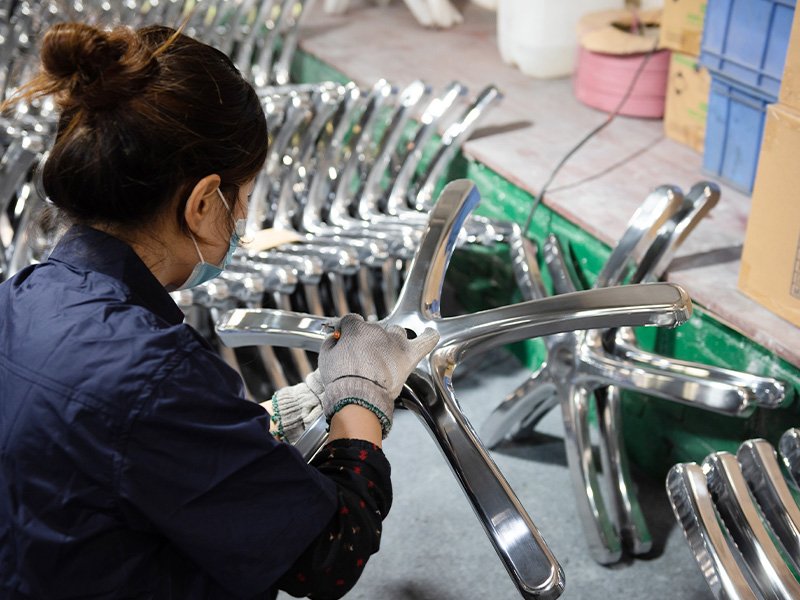
A swivel chair base looks simple, but for commercial and contract environments it is a component that quietly makes or breaks a chair’s lifespan. Constant rotation, heavy use, and demanding users put stress on the base that residential chairs never see. This guide explains what to look for when sourcing a swivel chair 5-point base for commercial use.
Why commercial swivel bases are different
In a home office, a chair base might see a few hundred rotations a day from a single user. In a call center, hospital, or 24/7 operation, the same base faces thousands of rotations from multiple users of varying weights, often around the clock. This intensity means a base rated “good enough” for residential use can fail prematurely in commercial service. Commercial specification is about designing for the worst case, not the average.
The five-point geometry advantage
The 5-point base became the standard for a reason: it is the optimal balance of stability and cost. A swivel chair 5-point base distributes the user’s weight across five contact points in a wide, even footprint, minimizing tip-over risk even when a user leans or reaches. This is a safety requirement in most commercial furniture standards — four-legged bases are generally not compliant for office swivel chairs precisely because they tip too easily.
What to specify for commercial use
Cycle-tested load rating
Do not accept a static load number alone. For commercial seating, insist on a dynamic, cycle-tested rating that reflects repeated real-world stress. A thickened office chair 5-star base with reinforced arms and hub is engineered specifically to survive these cycles without deforming or cracking.
BIFMA compliance
BIFMA testing is the international benchmark for office furniture durability. A BIFMA-compliant base has been validated for strength, stability, and cycle life — essential documentation for contract and institutional buyers who require proof of safety.
Caster socket precision
The caster sockets are a common weak point. Loose or inconsistent sockets cause wobble, uneven rolling, and premature caster failure. In high-use environments, socket precision directly affects how long the whole chair stays in service.
Material for the environment
For heavy commercial use, a metal 5-star chair base offers the highest durability margin. For humid or wash-down environments, corrosion resistance becomes a priority. Match the material to the real conditions the chair will face.
The coordinated-set advantage
A swivel chair base performs only as well as the components it works with. Sourcing the base, gas-lift cylinder, caster sockets, and casters as a coordinated set from one manufacturer eliminates the tolerance mismatches that cause wobble and field failures. This is especially important for commercial chairs where every failure means a service call.
For the full picture on materials, load ratings, and accessories, see our complete guide to 5-star chair bases. OneNest’s SHENHUI division manufactures commercial-grade five-star bases with the cycle-tested durability that contract seating demands — contact our team to spec the right base for your application.