
Dining Table Legs: A Sourcing Guide for Furniture Brands
A sourcing guide to dining table legs: metal vs solid wood, folding and height-adjustable systems, knock-down shipping, and quality checks for furniture brands.

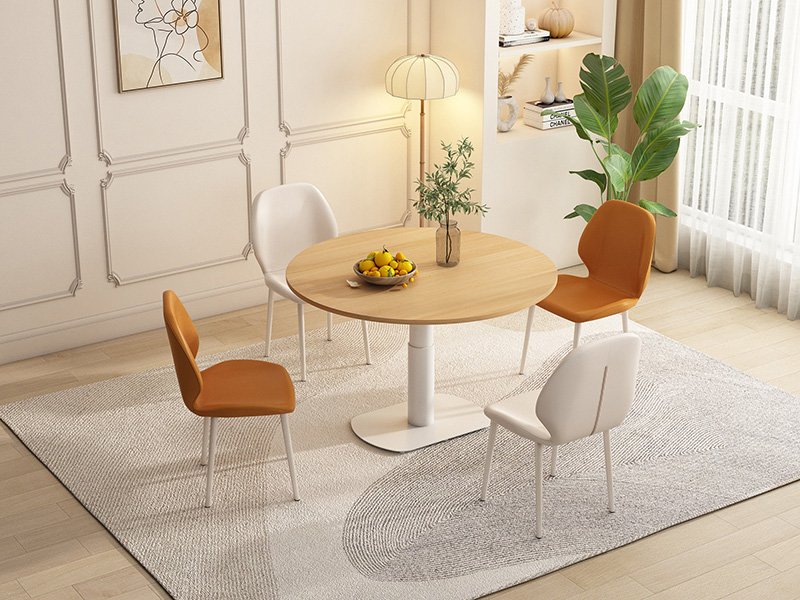
Dining table legs rarely get the attention they deserve. Buyers obsess over tabletops — the wood, the finish, the edge profile — while the legs that carry the entire structure are treated as an afterthought. Yet the legs determine whether a table wobbles, whether it survives commercial use, and whether it ships flat or arrives damaged. This guide walks furniture brands and procurement teams through everything that matters when sourcing dining table legs at scale.
Why dining table legs are a critical sourcing decision
The legs and base of a dining table handle every stress the table endures: the static weight of the top, the dynamic load of people leaning on it, lateral forces from being dragged across floors, and the constant micro-stresses of daily use. A poorly engineered leg or base translates directly into wobble, joint loosening, and eventually structural failure — the kind of problem that generates returns and destroys brand trust.
For commercial dining table legs in particular, the demands multiply. Restaurant and hospitality tables face far heavier use than residential ones, with constant seating turnover, aggressive cleaning, and heavy tabletops. Sourcing the right leg system is the difference between a table that lasts a decade and one that fails within a season.
Material options for dining table legs
Metal dining table legs
Metal dining table legs — in steel, stainless steel, cast iron, or aluminum alloy — dominate modern and commercial furniture. They offer the highest strength-to-footprint ratio, resist the wear of high-traffic environments, and enable slim, contemporary silhouettes that wood cannot achieve. Cast iron and heavy-gauge steel bases add the mass needed for stability under large tops, while aluminum keeps weight down for shipping efficiency. For any contract or hospitality project, metal legs are usually the default.
Solid wood dining table legs
Solid wood dining table legs remain the choice for traditional, farmhouse, and premium residential furniture. They convey warmth and craftsmanship, but demand careful sourcing: moisture content, joinery quality, and species selection all affect long-term stability. Wood legs are heavier to ship and more variable batch-to-batch, so consistency control is critical when ordering at volume.
Folding and height-adjustable dining table legs
Two specialized categories are growing fast in the market.
Folding dining table legs enable space-saving and portable tables — essential for events, small apartments, and flexible commercial spaces. The engineering challenge is a hinge mechanism that locks rigidly in use yet folds smoothly, without the play that causes wobble. A weak folding mechanism is the number-one failure point in this category.
Height-adjustable dining table legs bring the flexibility of sit-stand furniture into dining and multi-purpose settings. Whether pneumatic or mechanical, the adjustment system must hold position reliably under load and adjust smoothly — a growing requirement as furniture becomes more multifunctional.
Knock-down design: why it matters for shipping
One of the most overlooked sourcing factors is whether the legs ship assembled or knock-down (KD). Knock-down dining table legs detach from the tabletop for flat-pack shipping, dramatically reducing freight volume and shipping damage. For any brand shipping internationally, KD design can cut logistics costs significantly — but only if the connection hardware is precise enough to reassemble rigidly without wobble. This is a core engineering competency, not a minor detail.
Quality checklist for sourcing dining table legs
- Load and stability testing — validated performance under realistic dynamic load, not just static weight.
- Connection hardware precision — the single biggest factor in whether a KD or folding table wobbles.
- Finish durability — powder coating or plating that survives cleaning chemicals and daily abrasion.
- Floor protection — adjustable glides or feet that protect floors and compensate for uneven surfaces.
- Batch consistency — uniform dimensions and finish across the entire production run.
Matching legs to your application
For home dining table legs and accessories, prioritize aesthetics, ease of assembly, and floor protection. For commercial dining table legs, prioritize load rating, finish durability, and stability under constant use. For flexible or multi-purpose furniture, folding and height-adjustable systems open new product categories — provided the mechanism is engineered to last.
At OneNest, our KAIXIANG division brings 18 years of hardware customization to commercial-grade table bases in stainless steel, iron, cast iron, and aluminum alloy — with knock-down engineering designed for efficient global shipping. From standard OEM legs to fully custom bases built to your drawings, we can spec the right foundation for your tables.