
The Complete Guide to 5-Star Chair Bases for Office Furniture
A sourcing guide to 5-star chair bases: metal vs. nylon, load ratings, thickened bases, BIFMA quality signals, and how to specify the right base for your product line.

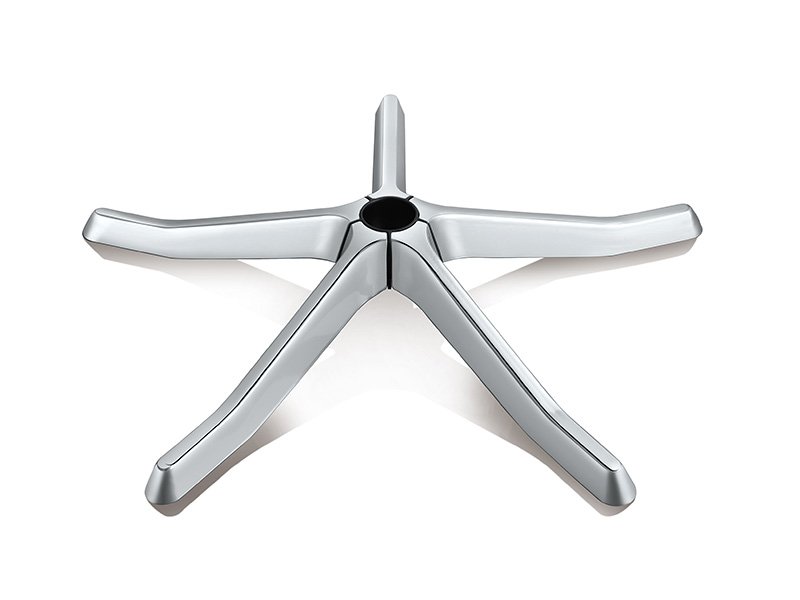
For furniture brands and procurement teams, the 5-star chair base is one of those components that is invisible when it works and catastrophic when it fails. It carries the entire load of an office chair, absorbs the stress of constant swiveling and rolling, and directly determines whether a chair feels premium or cheap. This guide covers everything a sourcing professional needs to know about 5-star chair bases — materials, load ratings, quality signals, and how to specify the right base for your product line.
What is a 5-star chair base?
A 5-star chair base (also called a 5-point chair base) is the five-legged foundation at the bottom of most office and swivel chairs. The five-arm design is not arbitrary: it is the engineering sweet spot for stability. Fewer legs increase tipping risk, while more legs add cost and weight without meaningful stability gains. The five-point geometry distributes the user’s weight evenly across a wide footprint, which is why it became the global standard for office seating.
Each arm terminates in a caster socket, and the center hub houses the gas-lift cylinder that enables height adjustment. Because every swivel, lean, and roll transfers force through this single component, the base is a critical safety and durability part — not a commodity afterthought.
Materials: metal vs. nylon 5-star bases
The single biggest decision when sourcing a 5-star chair base is the material. It drives cost, weight, load capacity, and the perceived quality of the finished chair.
Metal 5-star chair bases
Metal bases — typically aluminum alloy or steel — are the choice for premium and heavy-duty applications. Aluminum bases are often polished or powder-coated for a high-end aesthetic, while steel bases prioritize raw load capacity. A metal 5-star chair base signals quality the moment a buyer touches it: it has weight, rigidity, and a cold, solid feel that plastic cannot replicate. For executive chairs, ergonomic task chairs, and any product marketed as durable, a heavy-duty metal base is essential.
Nylon and reinforced plastic bases
Glass-fiber-reinforced nylon bases are lighter and more cost-effective, and modern reinforced polymers can meet the same BIFMA load standards as metal. They resist corrosion, never need coating, and suit high-volume, budget-conscious product lines. The tradeoff is perceived value — a plastic base rarely conveys the premium feel of metal, even when its performance is comparable.
Load capacity and the thickened base advantage
Load rating is where many cheap bases quietly fail. A base rated for a 100 kg user under static load may deform or crack under the dynamic stress of a heavier user leaning back repeatedly. This is why a thickened office chair 5-star base has become a key selling point: additional wall thickness in the arms and hub dramatically increases fatigue resistance and safe working load.
For commercial, contract, and 24/7 environments, always specify a heavy-duty base validated by cycle testing — not just a static load rating. A base that survives 100 kg once is very different from one that survives 100 kg across 200,000 sit-lean cycles.
Quality signals to check before you buy
- BIFMA compliance — the international benchmark for office furniture strength and durability testing.
- Cycle-tested load rating — ask for the dynamic load figure, not just the static maximum.
- Caster socket precision — loose or inconsistent sockets cause wobble and premature caster failure.
- Finish consistency — for metal bases, check for even coating with no thin spots that invite corrosion.
- Batch-to-batch consistency — the true test of a manufacturer is whether unit 10,000 matches the approved sample.
Choosing 5-star base accessories
A complete base solution includes more than the star itself. When sourcing 5-star chair base accessories, coordinate the base with compatible gas-lift cylinders, caster sockets, and casters rated for your intended floor type. Mismatched components are a common cause of field failures and warranty claims — sourcing them as a coordinated set from one manufacturer eliminates tolerance mismatches.
Specifying the right base for your product line
For a budget task chair, a BIFMA-compliant reinforced nylon base offers the best cost-to-performance ratio. For a mid-range swivel chair, a coated aluminum base balances aesthetics and durability. For executive, ergonomic, or contract-grade seating, a heavy-duty thickened metal base is non-negotiable — it protects both the user and your brand reputation.
At OneNest, our SHENHUI division produces five-star alloy chair bases on automated die-casting and precision punching lines, with documented quality systems and BIFMA-oriented testing. Whether you need standard OEM supply or a custom base engineered to your drawings, our OEM/ODM team can spec the right solution for your market.