
Five-Star Chair Base Load Testing: What BIFMA X5.1 Actually Requires, and What It Means for Component Sourcing
This article explains what BIFMA X5.1 requires specifically for the five-star chair base, why the standard is structured the way it is, and what the test parameters mean when you are making sourcing and specification decisions for a chair product line.

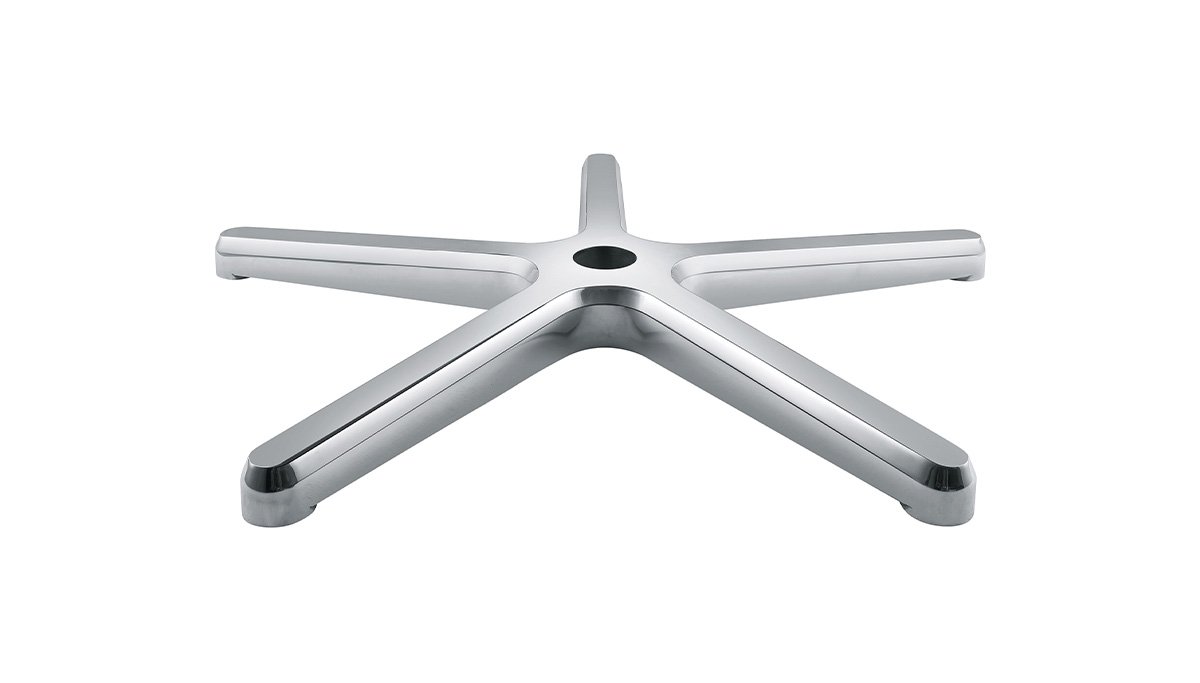
When furniture brands ask suppliers for BIFMA X5.1-compliant chair bases, both sides often have a vague understanding of what that actually means. The supplier says the base passes BIFMA. The brand checks a box. The test report gets filed somewhere. And neither party can tell you what specific loads were applied, how the base was supported during the test, or what the acceptance criteria actually were.
That information gap has consequences. A base that marginally passes the BIFMA base test under ideal lab conditions will not perform the same way inside a fully assembled chair under real user loads. A base specified against the wrong test standard — X5.1 versus X5.11, for example — will be under-engineered for its actual user population.
This article explains what BIFMA X5.1 requires specifically for the five-star chair base, why the standard is structured the way it is, and what the test parameters mean when you are making sourcing and specification decisions for a chair product line.
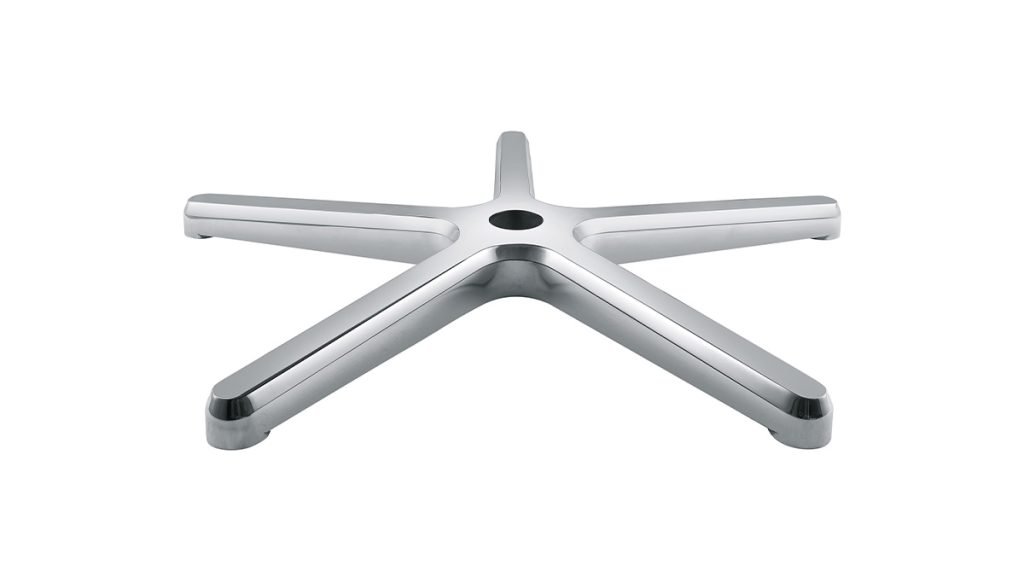
Why five legs, and why it matters for the tests
The five-star base became the industry standard for swivel office chairs for a reason grounded in geometry, not convention.
The stability of a chair base is determined not by the distance from the center hub to the tip of each arm, but by the radius of the inscribed circle of the polygon formed by connecting adjacent arm tips. This is the critical measurement that determines how far the base can be tilted before a caster leaves the ground. A larger inscribed circle radius means better resistance to tipping.
Working through the geometry: a four-arm base with the same arm length as a five-arm base has a smaller inscribed circle, because the angle between adjacent arms is 90 degrees rather than 72 degrees. To achieve equivalent stability with four arms, you would need to make the arms roughly 24% longer — which increases material use, footprint, and manufacturing cost, while also creating a base that conflicts with the user’s feet more often.
At six arms, the stability improvement relative to five becomes marginal (the inscribed circle increases by only a small percentage per additional arm), but material cost, assembly complexity, and floor-space footprint all increase. Five arms is genuinely the geometric optimum: the point where adding another leg yields diminishing returns. Research confirms that five-star bases remain stable at tilt angles of up to 20 degrees, whereas four-star bases can become unstable as low as 15 degrees.
This geometric foundation is why BIFMA X5.1 stability tests and base load tests are designed around a five-point base as the standard reference configuration. A base tested to BIFMA X5.1 using a five-star geometry has a specific stability profile — one that changes if you reduce to four arms or extend the arm length significantly.
The BIFMA X5.1 standard: what it covers and what it does not
ANSI/BIFMA X5.1 is a voluntary performance and safety standard for general-purpose office chairs, maintained by the Business and Institutional Furniture Manufacturers Association and recognized as the primary benchmark in the North American market. The 2017 edition (reaffirmed 2022) is the current applicable version. It replaced the 2011 edition with one significant change: the reference user body mass was increased from 253 lbs to 275 lbs (approximately 125kg), reflecting updated anthropometric data for the 95th-percentile male in the U.S.
This matters for the base specifically: higher reference mass means higher test loads applied to the hub, and base designs validated against the 2011 standard were not automatically compliant with the 2017 requirements without re-evaluation.
The standard covers 20 tests total, but not every test applies to every chair configuration. Tests are organized around three chair “types”: Type I (tilting), Type II (fixed seat, tilting backrest), and Type III (fixed seat, fixed backrest). For most commercial task chairs and executive chairs — the primary market for five-star aluminum and steel bases — Type I applies.
The tests relevant to the chair base specifically are:
- Seating durability tests (cyclic) — Section 7
- Seat static load test — Section 6
- Stability tests — Sections 9 and 10
- Caster/chair base durability test (cyclic) — Section 15
- Base informative test — Appendix C (not mandatory, but commonly included in SGS test packages)
Each of these is described below in the detail that actually matters for component specification.
The specific tests that apply to the base
1. Seat static load tests (Section 6)
This is the test most people refer to when they talk about “chair load capacity.” It applies load to the seat pan, not to the base directly — but the base is the ultimate load path, so this test exercises the entire structural assembly.
Two load levels are tested:
Functional load: 667 N (150 lbf) applied downward to the center of the seat for one minute. Acceptance criterion: no loss of serviceability — the chair must still function normally after the load is removed.
Proof load: 1001 N (225 lbf) applied downward to the center of the seat for one minute. Acceptance criterion: no sudden or major change in structural integrity. Some deformation is acceptable at proof load, but no fracture, no component separation, and no collapse.
The distinction between functional and proof loads is important. Functional load represents the design working load — what the chair is expected to see in normal daily use. Proof load represents misuse or extreme occupant weight, where structural integrity must be maintained even if the chair is not usable afterward. Manufacturers who report only proof load compliance are meeting the minimum; products that show zero permanent deformation at proof load have genuine design margin.
2. Seating durability test — cyclic (Section 7)
This is the long-duration endurance test that simulates years of use. A 102 kg (225 lb) load is applied to the seat in a repeated cycle — the standard specifies 200,000 cycles at the defined load and rate. The base must survive the full cycle count with no loss of serviceability.
200,000 cycles translates to roughly 10 years of single-shift office use at typical adjustment frequency. For chairs deployed in multi-shift environments — call centers, 24-hour operations — the test cycle count understates real-world exposure, and some specification-conscious buyers require manufacturers to demonstrate performance at higher cycle counts.
The base’s role in this test is primarily the hub-to-arm interface and the arm-to-nib (caster socket) joints. These are the stress concentration points where fatigue cracking initiates in poorly designed or manufactured bases. After 200,000 cycles, the base must show no cracking at welds (for stamped steel), no fracture at the hub (for die-cast aluminum), and no caster socket deformation that compromises caster retention.
3. Stability tests (Sections 9 and 10)
These tests evaluate tipping resistance — the chair must not overturn when a user leans, reaches, or applies horizontal force.
Rear stability (Section 9): A 600 N (135 lb) load is applied to the seat. A horizontal force of 93 N (20.9 lbf) is then applied at backrest height in the rearward direction. The chair must not tip over.
Front stability (Section 10): With 600 N on the seat, a downward force of 667 N (150 lbf) is applied to the front edge of the seat. The chair must not tip over.
For the five-star base, the geometry described earlier — inscribed circle radius and arm length — determines how easily the chair reaches the tipping threshold in these tests. A base with shorter arms relative to the hub-to-seat height will fail front stability more easily. This is why base splay angle and arm length specifications need to be validated against the full assembled chair, not the base component alone.
4. Caster/chair base durability test — cyclic (Section 15)
This test runs the assembled base (with casters) over a raised threshold strip under load for 200,000 cycles, simulating the wear on casters and base arms from rolling over door thresholds, carpet edges, and floor transitions over the product’s life.
The 75 lbf (334 N) load referenced in Section 15 applies during the rolling cycle. Caster arm nibs — the sockets at the tip of each base arm where casters insert — must retain the casters securely throughout. The arm itself must show no fatigue cracking at the nib shoulder, which is the highest-stress location during the rolling cycle.
This test is where the difference between die-cast aluminum alloy grade and recycled/secondary aluminum becomes visible. A well-formulated primary aluminum alloy (A380, ADC12) has consistent fatigue resistance across the arm cross-section. An inconsistently formulated casting with porosity or secondary alloy variation will develop micro-cracks at nib shoulders under cyclic loading that only become visible after hundreds of thousands of cycles — which is long after product shipment.
5. Base informative test (Appendix C)
This test appears in BIFMA X5.1 as “informative” — meaning it is not a mandatory pass/fail requirement for X5.1 compliance, but it represents the industry-accepted base-specific structural test. Many SGS test packages include it because buyers specifically request it, and it is the test most commonly reported when a supplier provides a standalone “base test report.”
Setup: The base is placed upside down. Pins are inserted into each nib (caster socket), and the base is supported at the pin contact points only, leaving the hub unsupported and facing upward.
Load application: A compressive load is applied downward at the hub. The standard references 2,500 lbf (approximately 11,100 N) as the minimum threshold.
Acceptance criterion: No permanent deflection or breakage. The base must survive the full load without any structural failure that could cause personal injury.
The 2,500 lbf figure was established based on shock load analysis — the kind of force transmitted to the hub if a user drops heavily into the chair, or if the chair is dropped during installation or moving. Well-designed aluminum die-cast bases typically survive to 3,500–4,700 lbf before failure, providing a safety factor of 1.4–1.9x over the minimum threshold.
The drop test component: the base is also subjected to a 300 lb (136 kg) weight dropped from 6 inches onto the hub with the base right-side up and casters installed. Again, no failure that would cause personal injury.
What these test parameters imply for sourcing decisions
Understanding the test structure changes how you evaluate supplier claims and test documentation.
The base static test (Appendix C) and the seat static test (Section 6) test different failure modes. A supplier who provides only the Appendix C base test report has demonstrated that the isolated base component survives the hub compression load. They have not demonstrated that the base, assembled into a complete chair, passes the seat functional and proof loads with appropriate safety margins. Require both.
Cycle count is where quality differentiation shows up. A base that barely survives 200,000 cycles leaves no margin for extended-use environments. If your chair product targets 24/7 operations or hospitality applications with multiple users per day, ask the supplier about demonstrated performance at 300,000–400,000 cycles, or specify a base designed with higher cross-sectional area at known stress locations.
The 2017 update to X5.1 (275 lb reference mass vs. 253 lb) increased seat functional load from 111 kg to 125 kg and proof load proportionally. Bases tested to the 2011 standard at exactly the minimum threshold are no longer formally compliant. Ask specifically: was this base tested to X5.1-2017 (R2022), or to an earlier edition? The test report will show the edition number.
For users in the 253–400 lb range, X5.11 applies, not X5.1. X5.11 is the large-occupant standard with proportionally higher loads across all tests. If your product is positioned for heavy-duty or bariatric applications, a base validated only to X5.1 is under-specified. The hub compression requirement in X5.11 base testing is correspondingly higher.
Alloy specification affects fatigue test results more than static test results. The Appendix C static test at 2,500 lbf is a relatively blunt instrument — it catches severely under-engineered or defective bases, but it does not discriminate well between good and marginal designs. The 200,000-cycle durability test is more discriminating, because fatigue resistance depends on alloy composition, wall thickness, and surface finish in ways that single-load static tests cannot capture.
The gap between BIFMA compliance and product quality
BIFMA X5.1 sets a floor, not a ceiling.
A chair base that exactly meets the minimum requirements at minimum test margins will feel and perform differently from a base designed with deliberate margin above those requirements. The difference shows up in product reviews, warranty claim rates, and the stability feel that end users report — or don’t report, because good chair bases are invisible when they’re working correctly.
Several dimensions of base quality that BIFMA does not evaluate:
Cylinder socket interface precision. The central bore that accepts the gas lift cylinder must be machined to tight tolerances. A loose socket causes the characteristic “column wobble” that users attribute to a cheap chair. BIFMA tests do not load-test the cylinder socket interface directly. This is a quality specification that must be confirmed through supplier process documentation and incoming inspection, not through test report review.
Finish durability and corrosion resistance. BIFMA X5.1 does not include salt spray or humidity cycling tests for the base material or surface finish. For chairs deployed in coastal environments, healthcare settings with regular chemical cleaning, or high-humidity regions, a powder-coated steel base may develop corrosion at chip sites within 18–24 months of commercial use. This is a procurement consideration that BIFMA compliance status does not address.
Caster retention force. The nibs at the tip of each arm must retain casters with enough friction to prevent accidental caster ejection, while still allowing removal for replacement. BIFMA’s caster durability test cycles the base under load but does not specify caster retention force directly. Under-tolerance nibs allow casters to pop out unexpectedly — a safety incident that generates warranty claims and, occasionally, injury reports.
Practical questions to ask when reviewing a supplier’s BIFMA documentation
If you are evaluating a chair base supplier and reviewing their test documentation, the following questions go beyond “do you have a BIFMA certificate”:
- Is the test report issued against X5.1-2017 (R2022) or an earlier edition? The edition number appears on the front page of any legitimate SGS or equivalent third-party report.
- Does the report include both the Appendix C base test and the Section 6 seat static tests on the assembled chair, or only the isolated base component test?
- What was the actual measured load-to-failure in the Appendix C hub compression test? The minimum threshold is 2,500 lbf. A supplier with genuine engineering confidence will share the failure point, not just state “pass.”
- Were the cyclic durability tests run at 200,000 cycles or above? If the product targets high-occupancy commercial environments, ask whether the supplier has data at higher cycle counts.
- Is the base covered under the same test certificate as the complete chair assembly, or is it separately certified? Some brands buy bases from one supplier and have the complete chair tested with a different base — a different supply chain from what they are actually shipping.
- For aluminum bases: what alloy was used, and is the alloy specification documented in the material traceability record? A test report on a sample lot is only as useful as the alloy consistency in production.
OneNest Furnitech manufactures both die-cast aluminum and one-piece stamped steel five-star chair bases at our Foshan production facility. SGS test reports to ANSI/BIFMA X5.1-2017 are available on request for standard SKUs. Custom base specifications can be evaluated against BIFMA requirements as part of the mold development process.