How to Vet a Furniture Component Manufacturer: A Procurement Checklist
A procurement checklist for vetting furniture component manufacturers: manufacturing depth, certifications, sampling, consistency, communication, and export record.

Choosing a furniture component manufacturer is one of the highest-stakes decisions a brand makes. The right partner protects your quality, margins, and reputation for years; the wrong one generates defects, delays, and warranty claims that erode trust with your own customers. This checklist gives procurement teams a structured way to vet suppliers before committing to a partnership.
1. Manufacturing depth: do they actually make it?
The first question is whether the supplier is a genuine manufacturer or a trading company reselling other factories’ output. A real manufacturer controls quality, pricing, and lead times directly. A middleman adds cost and a layer of opacity. Ask about their facilities, equipment, and production processes—a true manufacturer answers specifically and can show you the factory floor. Vertical integration, where a supplier controls multiple production stages in-house, is a strong signal of manufacturing depth.
2. Certifications: is quality documented?
Certifications turn quality claims into verifiable facts. Look for:
- ISO 9001 — a documented quality management system.
- ISO 14001 — environmental management compliance.
- BIFMA — the benchmark for office furniture strength and durability.
- SGS test reports — independent validation of load capacity and material quality.
- RoHS — confirmation that materials are free of hazardous substances.
Ask for actual certificates and test reports, not just claims. A serious manufacturer provides them readily.
3. Sampling and prototyping: can they prove it before you commit?
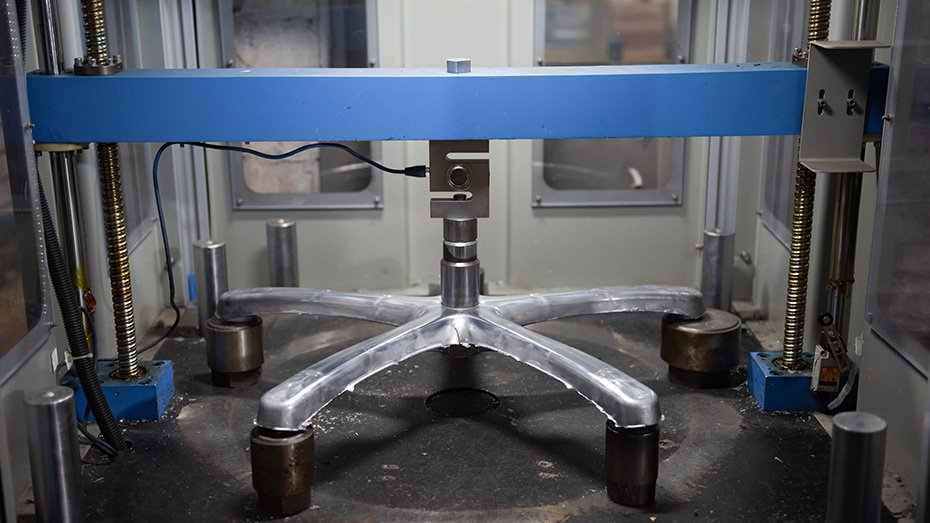
Before a large order, a capable supplier should provide samples that match your specifications exactly. Evaluate the sample rigorously—fit, finish, load performance, and consistency. A manufacturer confident in their quality welcomes sampling; one that resists or delays is a warning sign. For custom projects, assess their prototyping and engineering capability: can they take your drawings and turn them into a production-ready component?
4. Consistency: will unit 10,000 match the sample?
The hardest thing in manufacturing is not making one good unit—it’s making the ten-thousandth unit identical to the first. Ask about their quality control process: how do they inspect batches? What’s their defect rate? Do they have documented material traceability? Automated production lines generally deliver better consistency than manual processes. Batch-to-batch reliability is what protects you from the nightmare of a shipment that doesn’t match your approved sample.
5. Communication and responsiveness
Your day-to-day experience depends on communication. Test their responsiveness during the quoting process—if they’re slow and vague before you’re a customer, it rarely improves after. Look for a supplier who assigns a clear point of contact, responds within a reasonable window, and communicates in a way you can work with. Cross-border experience matters: a manufacturer who understands export logistics, compliance, and international standards removes friction.
6. Export track record
A manufacturer with a strong export history has already solved the problems that trip up inexperienced suppliers: documentation, packaging for long-haul shipping, customs compliance, and meeting the standards of demanding markets. Ask which countries and regions they export to, and how long they’ve been serving international clients.
The vetting checklist at a glance
- ✓ Genuine manufacturer, ideally vertically integrated
- ✓ Documented certifications (ISO, BIFMA, SGS, RoHS)
- ✓ Willing to provide accurate samples
- ✓ Documented QC and batch consistency
- ✓ Clear, responsive communication
- ✓ Proven export track record
OneNest was built to pass this checklist. With four vertically integrated facilities, documented certifications (ISO 9001, ISO 14001, IATF 16949, BIFMA-oriented testing, SGS, RoHS), in-house engineering and sampling, and exports to over 40 countries, we’re structured to be the reliable partner behind successful furniture brands. Learn more about our facilities or start a conversation with our team.